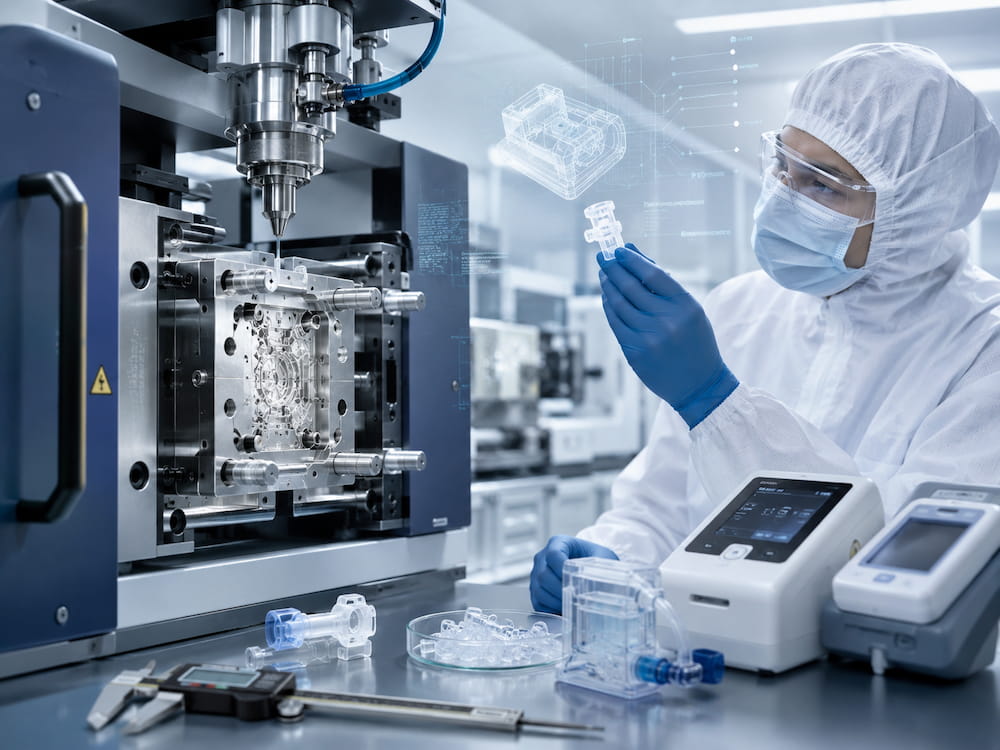
If you look closely at the supply chains driving the world’s most critical industries, you’ll quickly realize that success often hangs on the smallest, seemingly invisible components. We spend a lot of time talking about breakthrough surgical techniques, next-generation aerospace navigation, and bleeding-edge electronics. But behind every single one of those innovations is a physical, manufactured reality. When a surgical tool needs to perform flawlessly under pressure, or an electronic housing must withstand extreme environmental stress, manufacturers turn to custom plastic injection molding. This is not the mass production of cheap consumer goods; this is highly engineered, zero-defect manufacturing. Navigating this space requires a partner with deep institutional knowledge, which is why industry leaders rely on specialized firms like Plastic Molded Concepts (PMC). Armed with 50 years of hands-on experience and a rigorous ISO 9001:2015 certification, PMC has mastered the science of high-precision injection molding. Whether a project demands the specialized thermal properties of a specific polymer, or a manufacturer needs to dial in the exact shrinkage rates of a durable resin hdpe, PMC’s expertise helps clients build parts that simply do not fail.
While our focus here at the Healthcare Business Club is primarily on the medical sector, the crossover between medical, aerospace, and electronics manufacturing is undeniable. All three sectors operate under intense regulatory scrutiny and share a fundamental requirement: absolute, uncompromising accuracy. Let’s break down exactly how elite injection molding services take a raw concept and turn it into a high-performance reality.
The Zero-Defect Mandate in Critical Industries
When you are manufacturing a plastic component for a disposable toy, a minor structural flaw is an annoyance. When you are manufacturing a polycarbonate casing for an implantable medical device or a sensor housing for an aircraft, a structural flaw is catastrophic.
Regulatory bodies like the U.S. Food and Drug Administration (FDA) mandate stringent Quality System Regulations (QSR) for medical devices, meaning that every step of the manufacturing process must be traceable, repeatable, and validated. A premium injection molding partner acts as an extension of a company’s own compliance team. With ISO 9001:2015 certification, companies like PMC guarantee a documented, continuously improving quality management system. This level of oversight ensures that whether they are producing ten prototypes or a run of ten million units, the dimensional tolerances remain razor-sharp and identical.
Beyond the Basics: Overmolding and Insert Molding
The demands of modern healthcare and high-tech hardware have pushed past the capabilities of simple, single-material plastic parts. Today’s devices often require a combination of properties—like the strength of metal combined with the chemical resistance of plastic, or a rigid core wrapped in a soft, ergonomic grip. This is where advanced molding techniques become vital.
The Strategic Advantage of Insert Molding
Insert molding involves placing a pre-formed component—usually a metal piece like a threaded brass insert, a stainless steel surgical blade, or electronic pins—directly into the mold before the plastic is injected. The molten plastic flows around the insert, creating a single, tightly bonded, heavily reinforced component. In the medical field, this is how you create surgical instruments that require a metal cutting edge but a lightweight, sterile, plastic handle. In electronics, it is the standard for creating complex, secure connectors that won’t degrade over time. By combining materials in the mold, manufacturers eliminate the need for secondary assembly steps, reducing labor costs and dramatically increasing the part’s physical strength.
Overmolding for Ergonomics and Protection
Overmolding is a similar concept, but instead of metal, it involves injecting a second layer of plastic or rubber-like elastomer over a rigid plastic substrate. Think of the soft-touch grips on modern surgical drills, the water-resistant seals on electronic heart monitors, or vibration-dampening components in aerospace control panels. Overmolding not only improves the tactile feel and usability of a device—which is crucial for surgeons operating during lengthy procedures—but it also provides a seamless barrier against moisture, dust, and harsh sterilization chemicals.
The Blueprint to Success: Engineering and Material Science
You cannot simply carve a cavity into a block of steel, shoot hot plastic into it, and expect a perfect part. The physics of molten polymers are incredibly complex.
Precision Mold Design and Prototype Development
The success of an injection molding run is largely determined before a single drop of plastic is ever melted. The mold design phase requires intense computational analysis. Engineers must account for “gate placement” (where the plastic enters the mold), cooling channels (to ensure the part solidifies evenly without warping), and drafting angles (so the part can actually be ejected from the steel tool).
Elite molders will always champion rigorous prototype development. By creating rapid prototypes—often using specialized 3D printing or aluminum prototype tooling—engineers can test the physical part for structural integrity, fit, and function. This allows them to catch design flaws early, saving clients from investing tens of thousands of dollars in a permanent steel production mold that might otherwise need costly modifications.
The Deep Complexity of Material Selection
With thousands of engineered resins on the market, choosing the right material is a scientific discipline of its own. A plastic that works perfectly for a consumer electronic shell might melt instantly when exposed to the high heat and steam of a hospital autoclave.
Injection molding experts guide their clients through material selection by analyzing the end-use environment. Does the part need to be biocompatible? Does it need to resist UV radiation or aviation fuels, a standard monitored closely by the Federal Aviation Administration (FAA)? Does it require specialized additives for flame retardancy or structural fiberglass reinforcement? Having a partner with half a century of material science knowledge ensures that the selected resin will perform under exact real-world conditions without degrading or becoming brittle.
When the Unthinkable Happens: Forensic Failure Analysis
Even with the best planning, some manufacturers come to molding experts with existing parts that are failing in the field. Parts might be cracking under stress, warping out of shape, or snapping during assembly.
This is where a capability like forensic failure analysis separates a true manufacturing partner from a basic vendor. Instead of just guessing at the problem, experts at PMC conduct post-mortem investigations on failed plastic parts. Using advanced diagnostics, they look for microscopic clues:
- Weld Lines: Weak points where two flows of cooling plastic met but didn’t bond properly.
- Material Degradation: Evidence that the plastic was heated too high or for too long in the barrel, destroying its molecular chain.
- Environmental Stress Cracking: Signs that a chemical in the end-user’s environment is slowly eating away at the polymer.
By identifying the exact scientific root cause of a failure, the molder can adjust the tooling, tweak the processing parameters, or switch to a more resilient resin, permanently solving the issue and protecting the client’s brand reputation.
The Final Polish: Secondary Operations
The molding press is rarely the final stop for a high-value component. To deliver a truly finished, ready-to-market product, comprehensive injection molding services offer a suite of secondary operations. This allows the client to rely on a single vendor for the entire process, drastically simplifying supply chain logistics—a critical priority supported by initiatives from the National Institute of Standards and Technology (NIST).
Secondary operations can include ultrasonic welding to fuse two plastic halves together hermetically, pad printing or laser engraving to add corporate logos and critical medical tracking barcodes, and custom sub-assembly services. By keeping these operations under one roof, the molder maintains strict quality control over the component from raw pellet to final, packaged product.
Conclusion
In the demanding arenas of healthcare, aerospace, and advanced electronics, the phrase “good enough” simply does not exist. The components that power these industries must be durable, exact, and consistently flawless. Achieving this level of quality requires much more than heavy machinery; it requires deep engineering intellect, masterful mold design, and an unwavering commitment to quality control. By leveraging the expertise of seasoned, certified partners for high-precision injection molding, overmolding, and intricate material science, businesses can mitigate risk, accelerate their time to market, and ensure that their most critical products perform exactly as intended, every single time.
Did you find this article helpful? Check out the rest of our blog!
Read Also
- Innovative Technologies in Oncology: The Future of Cancer Treatment
 Have you ever wondered how far cancer treatment has come in recent years? Advances in technology are making a real difference in the fight against cancer. Today, more people are living longer and healthier lives after a cancer diagnosis. This is all thanks to new and groundbreaking medical advancements. The future of cancer care looks… Read more: Innovative Technologies in Oncology: The Future of Cancer Treatment
 - Cloud-Based Healthcare Administration Solutions: A Guide for Payers, TPAs, and Provider NetworksHealthcare administration has become too complex for disconnected spreadsheets, aging on-premise applications, and manual handoffs between departments. Organizations need technology that can manage claims, enrollment, billing, provider relationships, and member data as connected parts of the same operation. MCSI – Visova is one example, offering a cloud-native vpaas designed to support HIPAA-compliant healthcare administration. Its… Read more: Cloud-Based Healthcare Administration Solutions: A Guide for Payers, TPAs, and Provider Networks
- How Intelligent Invoice Processing Is Reshaping Healthcare AP WorkflowsWhat happens when healthcare invoice volumes outpace the AP team’s ability to review, validate, and route them, while cost per invoice keeps rising? That gap is pushing finance leaders past basic digitization. Supplier invoices across formats, systems, departments, and approval paths, and holding speed, accuracy, compliance, and visibility together gets harder at scale. Intelligent invoice… Read more: How Intelligent Invoice Processing Is Reshaping Healthcare AP Workflows
- From 1905 to 2026: How German Legacy Manufacturers Power Deutsche Dental Technologien’s SuccessFrom 1905 to 2026: How Busch & Co.’s Legacy Powers Deutsche Dental Technologien’s Success In an era where dental technology advances at breakneck speed, few companies embody the perfect blend of historic craftsmanship and modern business agility quite like Busch & Co. and its strategic partner Deutsche Dental Technologien. What began as a small dental bur factory in… Read more: From 1905 to 2026: How German Legacy Manufacturers Power Deutsche Dental Technologien’s Success
- Why the Future of Healthcare Administration is Cloud-NativeThe operational demands placed on modern healthcare administrators have officially outpaced the capabilities of traditional IT infrastructure. While clinical medicine continues to advance at breakneck speed, the back-office systems required to support it often remain painfully stagnant. Today’s insurers, Third-Party Administrators (TPAs), and provider networks are forced to navigate an avalanche of daily claims, aggressive… Read more: Why the Future of Healthcare Administration is Cloud-Native
- The Digital Overhaul: Why Modern Healthcare Administration Demands Advanced Technology SolutionsLet’s be honest about the current state of healthcare administration: it is staggering under its own complexity. The days of managing patient populations, claims, and provider networks with spreadsheets and disjointed legacy systems are long gone. Today, the sheer volume of data processing required just to keep a healthcare organization afloat is enough to paralyze… Read more: The Digital Overhaul: Why Modern Healthcare Administration Demands Advanced Technology Solutions
- Tech-Enabled Healthcare Innovation in Physical Therapy CarePhysical therapy is changing with the help of new technology. Digital tools are now used to support recovery and improve care. These tools help therapists track progress in a better way. Explore how technology is reshaping physical therapy with innovative digital tools. It highlights smarter recovery and patient outcomes in healthcare. Continue reading to discover… Read more: Tech-Enabled Healthcare Innovation in Physical Therapy Care
- 5 Best Payroll Error Detection Software for Healthcare in 2026Healthcare organizations operate some of the most complex payroll environments in any industry. Hospitals, skilled nursing facilities, rehabilitation centers, physician groups, and home healthcare providers must manage thousands of employees working across different shifts, departments, facilities, and compensation structures. Payroll teams are expected to process this information accurately while complying with labor regulations, organizational policies,… Read more: 5 Best Payroll Error Detection Software for Healthcare in 2026